Showing posts with label School. Show all posts

Friday, July 29, 2011

Higher Secondary Result 2011: Kerala Results Plus One 2011 Announced | Plus One Result 2011 Kerala, Plus Two Results 2011 Kerala, DHSE Kerala, DHSE Plus One Result 2011, Kerala Results


As of Thursday, the higher secondary result 2011 has been announced for the Kerala Plus One 2011 exam. Currently, the Kerala region is considered the most literate region in all of India, making education an extremely important facet of the area. The Plus One results for 2011 will be something many students look at for improvement in their educational careers.

The good news is the results are in! A report at NowPublic.com says as of Thursday, students can get results for secondary plus one results. To obtain the higher secondary exam results for first year 2011, students can check out the official website. By entering a roll number and clicking "submit" students can obtain their latest school test results.

This is likely a tense time for students in areas under the government of Kerala. The government of Kerala, private trusts and individuals run the schools and colleges of the regions. Students will be helping for good marks on the exams so they can continue with further educational and career aspirations. Best of luck to all of those as they embark on their futures and may today's results be satisfactory. Read More

Wednesday, July 27, 2011

CBSE students caught between school and board examinations | Ctet 2011 Result, Ctet Result, Ctet Result 2011, Ctet, Cbse Ctet Result


Class X students of Central Board of Secondary Education (CBSE) board are left with two options: school-based exams and board-based exams. With the final examinations fast approaching, students are still mulling over which one to opt for.

“The numbers of those taking the school exams are steadily rising. However, in my opinion, taking the board exam allows a student to keep his options open, especially if they haven't decided if they want to continue in the same school or shift boards,” said Mansoor Ali Khan,general secretary, Management of Independent CBSE Schools Association and secretary, Delhi Public School.

He added that the number of students taking the school-based exam has increased as compared to the previous year.

The role of parents plays a crucial role in deciding what the students should opt for.

“Such a decision should be taken in conjunction with parents because the students are too young to take such a decision themselves,” he said.

Venkat International Public School, for instance, advise their students to take up the board exam regardless of the choice.

“Even though, there is no difference in terms of preparation, students and teachers feel that board exams are more secure. Moreover, in a board exam, students need not feel that there is some sort of partiality being shown, since it is evaluated externally,” said school chairman, T Balakrishna. Read More

Tuesday, July 19, 2011

Spatial Thinking in the Geosciences | Research on Learning:Synthesis Study


Spatial thinking is thinking that finds meaning in the shape, size, orientation, location, direction or trajectory, of objects, processes or phenomena, or the relative positions in space of multiple objects, processes or phenomena. Spatial thinking uses the properties of space as a vehicle for structuring problems, for finding answers, and for expressing solutions (National Research Council, 2006).

Geoscience demands extensive spatial thinking from learners and practitioners (National Research Council, 2006; Kastens & Ishikawa, 2006). Geoscientists describe, and classify, and look for causal meaning in the shape of myriad objects in nature, inferring strain history from the shape of a mineral, temperature of an ancient ocean from the shape of a marine microfossil, and atmospheric conditions from the shape of a cloud. Students must master a variety of spatial representations, beginning with maps, cross-sections, and block diagrams, and moving on to unfamiliar specialized representations such as those showing directions of earthquake first motion, or the temperature/salinity structure of an oceanic water mass. Most geoscience data are collected in one or two dimensions; for example, seawater temperature is recorded by an instrument lowered on a wire from a research vessel (a 1-D data type). Students need to learn to combine data from 1- or 2-D information sources into a 3-D mental model of earth phenomena.

With respect to spatial thinking in the geosciences, we wish to know:
  • How do students learn to recognize which features in the shape or configuration of natural objects have significance, and how can educators foster that learning process?
  • How do people combine information gathered from multiple viewpoints into a single integrated mental model of the three-dimensional object or process, and how can that inherent human ability be harnessed to help students interpret 1-D or 2-D data sets in terms of 3-D processes?
  • To understand specialized spatial representations, such as phase diagrams of mineral stability fields or stereonet representations of folded rocks, the student needs to understand the process or structure being depicted. However, the means by which the process is best depicted is that same unfamiliar diagram. How can the learner break into this cycle, in which the process is conveyed through the representation, but the representation can't be deciphered without understanding the process?
  • To what extent do people who chose careers in geoscience self-select for high spatial skills, and to what extent does practice with geoscience tasks improve spatial thinking (Baldwin & Hall, 2002; Piburn et al., 2002)?
  • What teaching strategies are most effective for helping students with weaker spatial abilities understand geoscience concepts and master geoscience skills? If, as some research has found (National Research Council, 2006), spatial abilities differ by gender, finding answers to this question may help to increase the representation of women in the geoscience educational pipeline and workforce.

Research on specific courses and curricula has shown that performance on spatially-demanding tasks is resistant to change through geoscience education (e.g. Saliero, et al., 2005, demanding concerning causes of the seasons), and such tasks are ranked by many students as the most difficult in the geoscience curriculum (e.g. Hemler and Repine, 2006, concerning measurement of strike and dip). Recent studies have begun to tease out the nature of these difficulties. For example, Kali and Orion (1996) tested students' ability to envision the unviewed sides of a 3-D geological block diagram. They documented a category of profound "non-penetrative errors," in which students apparently failed to realize that the inside of the block would not be the same as the viewed surfaces. Through use of a survey instrument designed to probe students' conceptions about ground water, Dickerson, et al. (2005) found that misconceptions were often rooted in misunderstandings of scale or size.


References Cited
Baldwin, T. K. and M. Hall-Wallace (2002). Measuring spatial abilities of students introductory geoscience courses. Geological Society of America Abstracts with Program, Abstract 132-111.

Dickerson, D., Callahan, T. J., Van Sickle, M., & Hay, G. (2005). Students' Conceptions of Scale Regarding Groundwater. Journal of Geoscience Education, 53, 374-380.

Hemler, D. and T. Repine (2006). Teachers doing science: An authentic geology research experience for teachers. Journal of Geoscience Education, 54, 93-102.

Kali, Y. and Orion, N. (1996). Spatial abilities of high-school students in the perception of geologic structures. Journal of Research in Science Teaching, 33, 369-391.

Kastens, K.A. and T. Ishikawa (2006). Spatial Thinking in Geosciences and Cognitive Sciences, in C. Manduca and D. Mogk (Eds.), Earth & Mind: How Geoscientists Think and Learn about the Earth Earth. Geological Society of America Special Publication 413

National Research Council. (2006). Learning to Think Spatially Spatially. Washington, D.C.: National Academies Press.

Piburn, M., Reynolds, S. J., Leedy, D. E., McAuliffe, C. M., Birk, J. P., & Johnson, J. K. (2002). The Hidden Earth: Visualization of Geologic Features and their Subsurface Geometry. Paper presented at the National Association for Research in Science Teaching, New Orleans, LA.

Salierno, C., Edelson, D., and Sherin, B. (2005). The Development of Student Conceptions of the Earth-Sun Relationship in an Inquiry-Based Curriculum. Journal of Geoscience Education, 53(4), 422-431.

Spatial Thinking | Dictionary Australia, Dictionary For Kids, Dictionary Oxford, Directory, Formal Letters


The children whom I see once-a-week in an hour-long afternoon science enrichment class show growth in their exploration of building using ramps and blocks to create pathways for balls. These materials have been available each session for about four months. An hour once a week is not much time to explore a set of materials but the children seem to be able to pick up where they left off the last time. They enjoy making the balls go into a goal, creating elaborate structures around a few ramps, and making especially long ramps. Children drawing a set-up of blocks.Their work had seemed stalled so I assigned a task before building. I wanted to see how the children, ages 3.5-5, would approach the difficult task of drawing the relationship between two 3-D objects so I asked them to make a set-up with any two wooden (unit) building blocks and draw a picture of it. Most of the children made simple line drawings of one face of the blocks with varying degrees of accuracy (some were more oval than rectangular), and a few children traced the shapes. I hoped that this practice drawing would help them begin to think of how 3-D objects can be placed together and that thinking before building might lead to new structures.

(Note: In talking with the children I was searching my brain for the name given to the rectangular block and couldn’t come up with it. Not a cube but a ________. An online resource, The Annenberg Foundation’s Interactives: Geometry 3-D Shapes, gave me the word I was looking for. These unit blocks are polyhedrons, 3-D shapes whose faces are polygons, and specifically right prism polyhedron because the opposite sides are equal and they meet at right angles. The general term “rectangular prism” is appropriate. The site has a cool section where these shapes are shown unfolded.)

Nora S. Newcombe’s article in the Summer 2010 American Educator, Picture This: Increasing Math And Science Learning By Improving Spatial Thinking, has a fascinating discussion about spatial thinking skills and how to improve spatial thinking with some simple techniques. Newcombe asks, “Since spatial thinking is associated with skill and interest in STEM fields (as well as in other areas, such as art, graphic design, and architecture), the immediate question is whether it can be improved. Can we educate children in a way that would maximize their potential in this domain?” “In addition to practicing spatial thinking tasks like those shown in the box on page 30, well-conceived symbolic representations, analogies, and gestures are also effective in improving one’s spatial thinking ability.” She describes a study that shows that parents using spatial words like outside, inside, under, over, around, and corner help preschoolers improve their spatial thinking. Although “precise answers are not yet possible,” Newcombe says, “However, we are beginning to have some good ideas about where to start, especially with preschool and elementary students.”

Last week I challenged the children to first draw a ramp set-up that included at least two ramps and two blocks, and then build it. There were also sponges and plastic quart containers available. The children got to work drawing, some rushing to finish and some working more methodically. As they finished, they picked out materials and began building. Most of the 14 children referred to their drawings as they built, whether or not the structure closely matched the drawing.

One child announced that, “Mine’s not working!” I asked the group, What should he do?” and they responded, “Make a new plan!” He did. He went back to the table, re-drew his plan and then built a revised structure (which he was happy with) and continued working with for another 30 minutes. Two of the youngest children did not wander as they often did but spent the time engaged with building and ball-rolling. Another child had drawn a bridge-like structure with an up-ramp, level section, and a down-ramp. He tried to build it but could not get it to stay up. When I asked him what he wanted to do, he pointed to his plan indicating where he needed two supporting blocks. With a marker he drew in the supports, and then got two blocks to successfully build the revised structure.

To learn the most out of this activity, the children need time to investigate the relationship between the blocks, the slope of the ramps and the size and weight of the balls. They need time to play—did the ball make it into the hole?, time to compare—the heavy ball bumped off the path here but the light one kept going, time to think and talk about why, and time to revise their structures—“I’m going to make it better this time!” By designing, discussing their ideas, building, and revising their designs, I hope the children will gain experience with physical science concepts of force and motion while developing their spatial thinking. READ MORE

Websites trumpeting high school sexual slanders to the world | Mater Maria Catholic College, Barrenjoey High School Cromer High School, Narrabeen Sports High School, Northern Beaches Christian School, Pittwater High School, Stella Maris College, Brigidine College St Ives


THOUSANDS of Sydney school students are using social networking sites on which teenagers have been subjected to malicious sexual slander and cyber bullying.

''Root-rater'' and teenage gossip sites, based around schools or suburbs, have exploded in poularity in recent months but schools appear to be unaware of the extent of the problem.Northern Beaches Root Rates, a typical Facebook version, was pulled down on Thursday night when it had more than 1200 friends, drawn from schools including Mater Maria Catholic College, Barrenjoey High School Cromer High School, Narrabeen Sports High School, Northern Beaches Christian School, Pittwater High School, Stella Maris College, Brigidine College St Ives and Ravenswood School for Girls.A number of users had attended Freshwater Senior Campus which is part of the Northern Beaches Secondary College. Two students from another campus, Mackellar Girls, were targetted. About one girl an anonymous poster wrote: ''She goes all right but she had a really hairy bum whole [sic] and she squirts too much.''Another poster wrote of a girl: ''Chunky thighs, huge arse ... always available for a root for those who are hard up.''Ms Christine Del Gallo, principal at the Mackellar Girls campus in Manly Vale, said she had received no recent complaints of cyberbullying until contacted by the Herald."Action is being taken to identify the authors of this offensive material, which has also been referred to the department's Child Wellbeing Unit and the department's Safety and Security Directorate," she said.

"Any sexual references in cyber-bullying are offensive, and appropriate measures need to be taken to deal with them and to support the victims.''Most of the vile comments are made about girls and young women, although youths too are subjected to sexual ratings and abuse.NSW Police said vile gossip posts could lead to criminal charges such as stalk/intimidate or using a carriage service to threaten or menace. In a Sydney court last year a women was successfully prosecuted over threatening and inciting violence against another women on a social networking site. Similar charges were brought against a Sydney man in 2008. Read More

Maris Stella High School (MSHS) 新加坡海星中学 (Xing Jia Po Hai Xing Zhong Xue)


Maris Stella High School (Chinese: 新加坡海星中学, Abbreviation: MSHS) is an autonomous, SAP, Government-aided, all-boys Catholic secondary and primary school run by the international Marist Brothers at Mount Vernon Road in Singapore. It was headed by Bro. Anthony Tan from 1984 to 2009. Mr Joseph Lim Choon Kiat, the former Vice Principal, replaced Brother Anthony on 29 December 2009. It is placed in Band 3 in the 2010 School Achievement Table for Special/Express Course compiled by the Ministry of Education and, on that basis, is considered to be one of the top 20 schools in Singapore. Its teachers and students are also involved in non-academic fields including uniformed groups, sports such as archery, badminton, basketball, bowling, softball, table tennis, information technology, life sciences and Chinese debate.

Motto: 勤勉忠勇 (Diligence, Determination, Loyalty and Courage)
Location: 25 Mount Vernon Road, Singapore 368051,
Type: SAP, Autonomous, Government-aided
Session: Single session
Established: 1958
Principal: Mr Joesph Lim Choon Kiat
Enrolment: Approx. 1,500
Colour(s): Blue, black
Mission: The holistic development of each Marist that blends Faith, Culture and Life, with Respect to his human dignity.
Vision: A Marist Gentleman, Scholar and Sportsman

Source: Wikipedia

Friday, July 8, 2011

da vinci code, opus dei, franc maçonnerie, franc maçon: The Trials HD Riddle: A Look At Gaming’s Da Vinci Code

da vinci code, opus dei, franc maçonnerie, franc maçon: The Trials HD Riddle: A Look At Gaming’s Da Vinci Code


Most of you know Trials HD as the punishingly difficult 2D racer on Xbox LIVE Arcade – but buried deep within the impossible jumps and the incredible physics puzzles is something far more elusive – a riddle. A fiendish riddle that would make Da Vinci dribble. In this one-of-a-kind feature Kotaku reader, and Trials HD obsessive, FatShady breaks down this incredible puzzle and speaks to the creators of the game to try and uncover the intriguing mystery that is… The Trials HD Riddle.

The Beginning
But what is the Trials HD riddle? So far we have very little idea with regards to how the individual pieces hang together – but, for now, it’s a series of clues – buried deep within the tracks of Trials HD – clues that work together to create a bizarre mystery that is as yet unsolved, a series of Easter Eggs loosely tied together in a way we can’t yet fathom.

Few who play, or even finish the game in its entirety, will be aware of their existence. The clues found so far can be seen in this video. Read More

da vinci code, opus dei, franc maçonnerie, franc maçon: Da Vinci Code author Dan Brown 'most donated' to Oxfam


Da Vinci Code author Dan Brown's books topped the list of most donated to Oxfam shops, the charity has said.

The US writer has now taken the dubious accolade for three years in a row, ahead of Ian Rankin and Top Gear host Jeremy Clarkson in the latest list.

But Brown was third in the list of best-selling authors at the charity shop chain, up from 10th in 2010.

Stieg Larsson, Swedish writer of The Girl with the Dragon Tattoo, was Oxfam's best-selling writer.

He finished ahead of Sophie Kinsella, Brown and Stephenie Meyer, while JK Rowling was the sixth best-seller.

Mills and Boon romantic fiction titles and Joanna Trollope scored new entries at seven and eight.

Ian Rankin, who was the best seller last year, fell outside the top 10.

Twilight author Meyer finished fourth in the list of most donated authors, with Irish best-seller Maeve Binchy and racy writer Jackie Collins making the list for the first time.

Trollope, best known for titles including A Village Affair and The Rector's Wife, said she was "very gratified" to make the list and praised Oxfam for the "careful condition of its books and huge range of its titles".

The charity's new lists were announced as part of Bookfest, which runs until 17 July and features events at Oxfam shops around the UK including book signings and auctions. Reaad More

da vinci code, opus dei, franc maçonnerie, franc maçon: The bizarre mathematical conundrum of Ulam’s Spiral


If there's anything we learn from math teachers and the Da Vinci Code, it's that prime numbers are magic. They can do anything, and be anywhere. Including a doodle on a math paper.


In the 1960s, a gentleman known as Stanislaw Ulam was making his way through a miserable meeting by doodling on a piece of paper. Unlike most of us, who only manage to do 3D cubes and obscene drawings of people we don't like, Ulam tried filling his paper with math. And he discovered something very strange. Ulam drew a '1' at the center of his paper. Directly to the right of the one he drew a '2.' Above the two he drew '3', and continued spiralling the numbers outwards toward from the one. When he was done filling up the page, he decided to circle all the prime numbers - the numbers divisible only by one and themselves.

What he found was a lot of diagonal lines. They crisscrossed the paper, sometimes in short bursts and other times in long strings. While there are plenty of singularities and outliers, a large plot of the primes on Ulam's Spiral shows a remarkable density of diagonals. Further plotting with computers show that these diagonals appear even when the numbers get high, and even when the spiral doesn't originate with the number one. Change the spiral from one that's plotted on a grid to one that's plotted on a circular spiral, and the lines will change direction, but they'll still be there. Plot it on the hexagon - more lines.

It's things like this that make prime numbers so eery. They keep showing up in nature, in important functions, and in pure mathematical play. (I think they're the ghosts of ancient Greek numerals. Read More

OJEE 2011 Counselling; OJEE 2011 Web Based Counselling Schedule 2011

OJEE 2011 Counselling; OJEE 2011 Web Based Counselling Schedule 2011

The web based Counseling Schedule of Orissa Joint Entrance Examination is published.

Online Registration and Choice Filling starts on 03.07.2011 for Lateral Entry Engineering, MCA/MBA, Pharmacy programmes. For Engineering Programmes it starts on 08.07.2011 to 19.07.2011

Detailed rank wise schedule for different disciplines will be notified soon in OJEE website www.odishajee.com, www.oiee.nic.in and in newspapers.

LIST OF NODAL CENTRE FOR DOCUMENT VERIFICATION AND DEPOSIT OF FEES
  • Veer Surendra Sai University of Technology Burla, Sambalpur,
  • Indira Gandhi Institute of Technology Sarang (Parjang), Dhenkanal,
  • College of Engineering & Technology, Techno Campus, Ghatikia, Kalinga Nagar, Bhubaneswar,
  • Centre For IT Education, Plot No.-4, Mancheswar Industrial Estate, Bhubaneswar,
  • International Institute of Information Technology, Gothapatna, Malipada, Bhubaneswar,
  • 6. Central Institute of Plastic Engineering and Technology, B-25, CNI Complex, Patia, Bhubaneswar-751024,
  • Orissa University of Agriculture & Technology, Bhubaneswar,
  • BJB Junior College, Bhubaneswar,
  • Madhusudan Industrial Training Institute, Cuttack,
  • Institute of Textile Technology, Choudwar, Cuttack,
  • North Orissa University, Sri Ram Chandra Vihar, Baripada,
  • Fakir Mohan University, Balasore,
  • Govt Autonomus College, Rourkela,
  • Govt. ITI, Rourkela,
  • Berhampur University, Bhanja Bihar, Berhampur,
  • Kha 11 ikote Autonomous College, Berhampur,
  • Govt. ITI, Bhawanipatna,
  • Vikram Dev (Autonomous) College, Jeypore, Koraput.
Read More

Overbalanced Wheel: The Shifting-Mass Overbalanced Wheel

Overbalanced Wheel: The Shifting-Mass Overbalanced Wheel

From the 8th century to the present time inventors have sought to achieve perpetual motion by use of wheels with shifting weights. None have worked, but that doesn't stop people from using the same idea again and again, altering mechanical details, often with incredibly complex designs. I call this "reinventing the square wheel".


Bhaskara's first
perpetual motion wheel.
Mercury in curved spokes.
Bhaskara wheel with
mercury in tilted vials.
Overbalanced wheel with
weights on articulated arms.
18th century.

Early articulated-mallet wheel. Articulated arm wheel.
Often called the "Arabian Wheel".
Rolling-ball wheel.
17th century.
Note on the pictures. The early wheels are redrawn from an Arabian manuscript dated between the 9th and 12th centuries CE. All except the rolling ball wheel probably originated in 8th century India.

We have rotated some of them to correctly relate to gravity. The earliest known manuscripts had already passed through the hands of a number of copyists, and are difficult to interpret, especially for historians not skilled in mechanics. Note particularly the "Arabian Wheel". When correctly oriented, as shown here, this shows remarkable attention to the correct detail of how the hinged arms curve when hanging under the force due to gravity. The original must have been conceived by someone who understood this very well, or who actually had built such a mechanism.

Quite a number of books tell of this futile quest, citing examples with nice pictures of the failed designs. Few of these books give a simple conceptual explanation of why they don't work and why they can't work. Nor do these books expose the flaws of thinking that led people to believe they might work.

The physicist is tempted to cite conservation laws of energy, momentum, and angular momentum, or do a force and torque analysis, perhaps even mentioning cenripetal force. These concepts are not well understood or even accepted by the non-scientist reader.

Can these wheels be analyzed using simple, conceptual physics, and simple concepts such as force, mass, velocity, acceleration and work, with appeal to examples from everyday experience that most people understand and accept? I shall try, and I'll also try to keep this discussion at the level of a freshman college physics course.

Overbalanced wheels are of little interest to the physicist, for physicists understand, from many well-established laws and many lines of argument, that even if there were such a thing as perpetual motion, this is certainly not the way to achieve it.

All of these wheels use geometric design or mechanical devices to shift mass to a larger radius from the wheel's axle. We can only speculate what the inventors assumed to be the operating principle. Here are three possible reasons for motion, expressed in modern terminology:

More mass is kept continually on one side of the axle, presumably unbalancing the wheel to sustain rotation in one direction.
The masses on one side of the axle continuously have greater torque, supposedly unbalancing the wheel to cause rotation on one direction.
As each weight shifts to larger radius, an impulse is given to the wheel, sustaining rotation.

While these "reasons" for the wheel's supposed operation are invalid, they are still very seductive to someone with only casual experience with mechanisms. Such people will then suppose that the wheel's operation causes the output to be somehow greater than the input. Greater what? Greater force? Greater work? Greater power? In the days before force, work, and power were understood, this question would not have been asked, for inventors were probably thinking only of what we now call "work", the ability to raise heavy weights (as in pumping water), or run a gristmill or sawmill. Such a machine would supposedly perform these operations with smaller input effort. In later centuries, when concepts of force, work and power were better understood, PMM inventors still thought that perhaps such a machine could multiply work and power.

In any of these cases, the motive principle might be supposed to (a) cause the wheel to accelerate, or (b) simply deliver greater power output at constant speed. The second possibility is seldom mentioned in the perpetual motion literature. But some inventors showed a brake in their designs, to prevent the machine's speed to increase to dangerous values. If the machine were driving a grinding wheel or lift pump, presumably the load on the output would be considered sufficient to maintain constant speed of the machine.

But all of these wonderful speculative fantasies mean nothing if the wheel simply refuses to turn, and that's exactly what happens with any of these wheel designs. Such failure could always be rationalized by saying "The friction prevents the motion. Reduce the friction and it will surely work." But friction isn't the problem. Reduce the friction and the machines still refuse to turn even when all friction and other energy-dissipative processes are totally eliminated.

The inventors overlook some important basic physics. The earlier inventors can be excused, since those physics principles were not yet well understood. Inventors today who recycle modifications of the same designs have no excuse.

Imagine a wheel with regularly spaced spokes and masses on spokes. The masses are located at the middle of each spoke. Let the wheel's rotation axis be vertical, so the wheel is rotating in a horizontal plane. Suppose one of the masses is suddenly released so it moves out to the end of its spoke, where it is stopped by some restraint or catch. How will this change the rotation speed of the wheel?

To illustrate what really happens, consider an experiment that anyone can perform. Attach a weight on the end of a rope and swing the weight around a horizontal circle. Anyone who has done this knows that if the rope is released to allow the weight to suddenly move to a larger radius, the stone's angular speed (revolutions/time) decreases. Also, the weight's speed decreases, though that fact is not readily apparent to the eye. Its kinetic energy of motion is now smaller. That's not encouraging. This happens because the rope does negative work on the stone during the change of radius. If the rope is "let out" gradually, or if the rope only exerts force to stop the stone at the new radius, the force the rope exerts on the stone is opposite to the stone's displacement. Therefore the rope does negative work on the stone. This is equivalent to saying that the stone does positive work on the rope, and ultimately work is done on whatever the rope is attached to at the center of rotation. [For physicists reading this, we note that conservation of angular momentum applies, and the rope tension provides nearly zero torque, so the product of moment of inertia and angular velocity remains nearly constant.]

Perpetual motion wheels are invariably cyclic, that is, all motions of the wheel and its parts are repeated exactly during each complete revolution. So if a weight moves to a larger radius once per cycle, it must also be pulled back to the original radius later during the cycle. The work done in changing the radius by a certain amount from large to small is equal and opposite to the work done in changing the radius by the same amount from small to large. We gain no net energy per cycle.

Now imagine such a rotation in a vertical plane, so that gravity can play a role. Since the wheel's motion is cyclic, and the motion of the mass is cyclic, the work done on the mass by gravity as the mass moves down is of equal size to the work it does against gravity moving back up. There's no gain in net energy per cycle.

One of the most fundamental and well-tested facts of physics is that forces combine by vector addition. [This is sometimes called the "superposition principle" of force.] When two forces act on a body simultaneously, the net effect on the body is simply the vector sum of the forces. From this follows the result that when two forces do work on a body, the net work done on that body is the same as the work done by the vector sum of those forces.

We have seen that the radially shifting mass alone does no net work on the wheel during each cycle. We have also seen that gravitational force does no net work on the wheel or the mass during each cycle. So the two processes acting together will do no net work on the wheel during each cycle.

This is an outline of the reasons why physicists understand that all overbalanced wheels, no matter how ingeniously constructed, can never provide more energy than they were given initially. In fact, the situation is even worse, for the more ingenious and complex is the mechanism for maintaining the overbalance, the more poorly the wheel will perform due to mechanical inefficiency. Read More

RPMT counselling contact number


RPMT Admit Card 2011 will be issued by Rajasthan University of Health Sciences (RUHS) shortly. Rajasthan Pre Medical Test (RPMT 2011) is scheduled to be held on 22nd May 2011. As per info available in the RPMT 2011 ..

RPMT Admit Card 2011 will be issued by Rajasthan University of Health Sciences (RUHS) shortly. Rajasthan Pre Medical Test (RPMT 2011) is scheduled to be held on 22nd May 2011.

As per info available in the RPMT 2011 notification, Roll No. & Details of Centre allocated for RPMT will be issued after 15th May 2011. So it is expected that RPMT 2011 admit card is going to be issued shortly.

Candidates will be able to get information regarding Roll No. & Details of Centre allocated on RUHS website.

First Counseling for MBBS, BDS will be held on 15 – 17 July 2011, second Counseling from 25-27 August 2011. RPMT 2011 counseling for all courses will be organized at R.U.H.S., Pratap Nagar, Jaipur. Read More


Thursday, July 7, 2011

logic gate (AND, OR, XOR, NOT, NAND, NOR, and XNOR) | Logic Gates

logic gate (AND, OR, XOR, NOT, NAND, NOR, and XNOR) | Logic Gates

A logic gate is an elementary building block of a digital circuit . Most logic gates have two inputs and one output. At any given moment, every terminal is in one of the two binary conditions low (0) or high (1), represented by different voltage levels. The logic state of a terminal can, and generally does, change often, as the circuit processes data. In most logic gates, the low state is approximately zero volts (0 V), while the high state is approximately five volts positive (+5 V).

 
The AND gate is so named because, if 0 is called "false" and 1 is called "true," the gate acts in the same way as the logical "and" operator. The following illustration and table show the circuit symbol and logic combinations for an AND gate. (In the symbol, the input terminals are at left and the output terminal is at right.) The output is "true" when both inputs are "true." Otherwise, the output is "false."

/WhatIs/images/and.gif (220 bytes)
AND gate


Input 1Input 2Output
000
010
100
111
 
The OR gate gets its name from the fact that it behaves after the fashion of the logical inclusive "or." The output is "true" if either or both of the inputs are "true." If both inputs are "false," then the output is "false."
/WhatIs/images/or.gif (224 bytes)
OR gate


Input 1Input 2Output
000
011
101
111
 
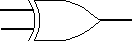
The XOR ( exclusive-OR ) gate acts in the same way as the logical "either/or." The output is "true" if either, but not both, of the inputs are "true." The output is "false" if both inputs are "false" or if both inputs are "true." Another way of looking at this circuit is to observe that the output is 1 if the inputs are different, but 0 if the inputs are the same.


XOR gate


Input 1Input 2Output
000
011
101
110
 
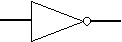
A logical inverter , sometimes called a NOT gate to differentiate it from other types of electronic inverter devices, has only one input. It reverses the logic state.


Inverter or NOT gate


InputOutput
10
01
 
The NAND gate operates as an AND gate followed by a NOT gate. It acts in the manner of the logical operation "and" followed by negation. The output is "false" if both inputs are "true." Otherwise, the output is "true."
/WhatIs/images/nand.gif  (240 bytes)
NAND gate


Input 1Input 2Output
001
011
101
110
 
The NOR gate is a combination OR gate followed by an inverter. Its output is "true" if both inputs are "false." Otherwise, the output is "false."
/WhatIs/images/nor.gif (237 bytes)
NOR gate


Input 1Input 2Output
001
010
100
110
 
The XNOR (exclusive-NOR) gate is a combination XOR gate followed by an inverter. Its output is "true" if the inputs are the same, and"false" if the inputs are different.
/WhatIs/images/xnor.gif  (278 bytes)
XNOR gate


Input 1Input 2Output
001
010
100
111
Using combinations of logic gates, complex operations can be performed. In theory, there is no limit to the number of gates that can be arrayed together in a single device. But in practice, there is a limit to the number of gates that can be packed into a given physical space. Arrays of logic gates are found in digital integrated circuits (ICs). As IC technology advances, the required physical volume for each individual logic gate decreases and digital devices of the same or smaller size become capable of performing ever-more-complicated operations at ever-increasing speeds. Source: http://whatis.techtarget.com

Logic Gates: Graphene Logic Gates: Low Power, High Gain


Miniaturization and power optimization are hot topics in microelectronics, with special focus on building next generation logic devices. Replacing current silicon-based complementary metal-oxide semiconductor (CMOS) technology requires a material to have high carrier mobility and short scaling length. Graphene has been hailed as such a candidate. New work now demonstrates that the use of lithographically prepared bilayer graphene (BLG) transistors in logic gates is feasible when following a modified self-adaptive architecture.

BLG transistors are inherently ambipolar, making them unsuitable for logic development, but through the use of charge neutrality points (CNPs) inherent to graphene, the transistors can be switched between n- and p-type. This switchability/self-adaptability is achieved through the use of a supply bias (VDD). To enhance this process, an electrostatic doping modulation is introduced via an added dielectric layer, a technique that seems less invasive than doping. The addition of this layer is easily done the current fabrication technologies. With the use of this modified architecture, the transistors show switchability at much lower VDD values.

The devises are tested firstly in a simple NOT gate consisting of a complementary pair of transistors. Parameters including voltage gain and output swing are the most interesting, especially in a regime where VDD is kept below 1V (low power regime). A rise in the performance is marked, with an output swing of up to 90%, and it is stated that with added band-gap engineering the switching ratio can be improved. More complex NAND and NOR gates are also demonstrated for the first time using graphene, illustrating the feasibility of this technique in preparing logic devices. Read More

Logic Gates: Creating new advanced tools that can build molecule-sized computer chips


Tools that are able to build computer chips 1000 times smaller than a grain of sand. That's what experts from around the world will be talking about when they gather at A*STAR's IMRE for a workshop on atomic scale interconnection machines. The tools are vital to the European Union's €10 million Atomic Scale and Single Molecule Logic Gate Technologies, or AtMolproject in which IMRE is the only non-EU partner. The project lays the foundation for creating and testing a molecule-sized processor chip.

These tools physically move atoms into place one at a time to construct atomic scale circuits at cryogenic temperatures and are also able to interconnect the tiny circuits to the external environment. The machines are essentially miniature high precision scanning tunnelling microscopes that can image a surface with picometer precision and manipulate one atom or molecule at a time. They are coupled to a high-resolution electron microscope that allows a researcher to position interconnects to make an atomic scale circuit. This method is a leading alternative in the race to achieve continued miniaturisation of nanoelectronic devices. It is estimated that conventional methods for shrinking devices will reach their miniaturisation limit in 10-15 years and cannot be reduced further. Speakers from Europe, USA, Japan, Canada, Australia and Singapore will discuss advancements in such ultra-high vacuum (UHV) tools and plans for the next generation tools.

"Because we are working at the scale of the atom, our tools have to be ultra high-precision and of extremely high-calibre, just like IMRE's UHV interconnection machine, which is one of the three in AtMol that can study the performance of single molecule and surface atom circuit logic gates", said the AtMol project leader, Prof Christian Joachim of the French Centre National de la Recherche Scientifique (CNRS) and an A*STAR Visiting Investigator at IMRE. Prof Joachim's team in IMRE is one of the pioneers in atom technology, having built the world's first controllable molecular gear and constructed the smallest digital logic gate with a single molecule. "This workshop brings together the world's foremost experts to discuss the latest in atomic interconnection machine technology and how this can quicken the pace towards a working molecular chip."

"The tools and the level of expertise that IMRE is contributing to this project show that the research in Singapore is truly at the cutting edge of global science", said Prof Andy Hor, Executive Director of IMRE. "IMRE is extremely glad to host the event and be a part of a truly momentous scientific effort."

The AtMol project aims to create a prototype molecular processor or a 'concept chip' in about four years time. The project will establish a comprehensive process for making the molecular chip using the three unique ultra high vacuum (UHV) atomic scale interconnection machines to build the chip atom-by-atom. The AtMol project was launched at the start of 2011 with 10 organisations from across Europe and IMRE in Singapore.

About the AtMol project
AtMol will establish comprehensive process flow for fabricating a molecular chip, i.e. a molecular processing unit comprising a single molecule connected to external mesoscopic electrodes with atomic scale precision and preserving the integrity of the gates down to the atomic level after the encapsulation. Logic functions will be incorporated in a single molecule gate, or performed by a single surface atomic scale circuit, via either a quantum Hamiltonian or a semi-classical design approach. AtMol will explore and demonstrate how the combination of classical and quantum information inside the same atomic scale circuit increases the computing power of the final logic circuit. Atomic scale logic gates will be constructed using atom-by-atom manipulation, on-surface chemistry, and unique UHV transfer printing technology.

Source: A*STAR

Logic Gates: Digital Logic Gates Just Using Transistors


There are times when you want to incorporate some basic logic into your designs but your available pcb space is limited, or maybe you would like a cheaper alternative to the more costly IC option.

Transistors used in these circuits can be any npn transistor such as BC547, BC548, BC549, 2N3904 etc.

Diodes can be almost any type so long as they can handle the reverse voltages in your design. LED's were only used to provide a visual reference to show these circuits in action.

Experiment on breadboard first before you use any of the circuits shown, All were tested before publishing and All of the component values can easily be played around with to meet your needs.

inputs can be virtually any signal source from timers to oscillators and more, or even push buttons and reed switches and so on.

I came up with these circuits back in 1995 when i studied Electrical Engineering in college, i quickly moved onto microprocessors so i never got a chance to put these designs into practice apart from a test probe below which uses my NOT gate design, so i would love to hear any ideas you have or maybe you are putting one into practice right now, please let me know.


2 input AND Gate
Both inputs need to be high to switch the output on.

2 input NAND Gate
Both inputs need to be on to switch the output off, if both inputs are high then the output is low. Both Diodes are needed to prevent feedback, The input resistors could be lower values if used in a lower voltage circuit or input voltages are less than 9v. The 220 ohm and 500ohm resistors are required to make the circuit switch on and off.The 1K Base resistor could be changed for a variable resistor to create a variable output voltage.

NOT Gate
The result is the opposite of the input, if the input is high then the output is low, somtimes called an inverting buffer, although buffers generally have a high output voltage compared to standard logic gates.

2 input NOR Gate
Output is high until one or more of the inputs are used. More inputs can easily be included, as you can see the inputs share the same transistor base, you may need to add diodes to each input if you need to prevent any feedback or if you come across any problems, if there are switching errors you could also change the resistor values for each input, the 2 existing diodes are there to prevent basic switching errors.

:: A Simple Practical Useful application with the NOT Gate above ::
:: Test Probe / Continuity Tester ::

Every now and again you may need to test a circuit board for short circuits or broken tracks so this handy little gadget should help you out.

The probes can either be a pair of crocodile clips or purpose made probes which you should be able to source from any good component supplier, if you wanted you could even integrate them onto the PCB with the rest of the circuit.

I designed this circuit to run on 2 AA or AAA batteries but you could also use a 3V button cell commonly used for car remote key fobs, do as much testing as you can before any sensitive components are fitted, although there is only around 800mv to 1.5v running through the probes, its better to be safe than sorry.

When the circuit is live, the red LED is lit but when the probes come into contact with a solder bridge or a short circuit is found, the red LED switches off and the green one lights up. Other fault checking could include broken tracks, in which case the led will remain red and aid in tracking down the problem areas.

How it works is fairly simple.
The transistor connected to the red LED will only stay on while there is no contact between the probes, as soon as the second transistor is switched on, there isn't enough power for the first one so it switches off, The 220 ohm resistor helps block the power to the first base while it flows into the second transistor which is now switched on.

I am working on a simple cheap Analog to Digital Converter at the moment so if you would like to see it and some other great stuff please click the follow button to keep an eye on my future instructables. Read More

Saturday, July 2, 2011

Singapore Hosts 3rd ASEAN Schools Games (ASG) 2011


1- Singapore will host the 3rd ASEAN Schools Games (ASG) from 1 – 7 July 2011. The ASG aims to promote ASEAN solidarity through school sports, while providing opportunities for school athletes to benchmark their sporting talents in the ASEAN region. This is the first time that Singapore is hosting the ASEAN Schools Games.

2- Come July, over 1,100 student-athletes from 7 ASEAN nations (Brunei, Indonesia, Malaysia, Philippines, Singapore, Thailand and Vietnam) will compete in a total of 12 sports - Badminton, Basketball, Golf, Gymnastics, Hockey, Netball, Sepak Takraw, Swimming, Table Tennis, Tennis, Track and Field, and Waterpolo (Boys only). To participate, athletes must be below 18 years of age and be full-time students of schools or junior colleges in the participating ASEAN countries. (Refer to Annex A (40kb .pdf) for information on the ASG and ASEAN Schools Sports Council).

3- The competitions will be held at 13 venues across the island. Student-athletes and officials will be housed at the Games Village in Nanyang Technological University. There will be over 200 student-athletes in the Singapore’s contingent for the 3rd ASG.

4- Student-athletes and officials will participate in a culture and education programme (CEP) during their stay in Singapore that promotes understanding and cross-cultural interaction. The CEP comprises a cultural festival during the opening of the Games Village on 30 Jun, evening cultural showcases during the Games and a learning journey. Through the ASG, our schools can also enhance their students’ knowledge of ASEAN and how sports has brought ASEAN nations together. Students can get involved as cultural performers or volunteers. They can also attend the sports competitions to show their support for the student-athletes and participate in sports outreach booths at some of the venues.

5- The logo for the 3rd ASEAN Schools Games comprises a torch with 10 tongues of flame, symbolising the 10 ASEAN member countries. The logo, in ASEAN colours of blue, red, white and yellow, is also reminiscent of a lion head, representing the host country of Singapore (Refer to Annex B (440kb .pdf) for details on the 3rd ASG logo).

6- The ASG and Singapore Youth Festival 2011 will be opened on 1 July at a joint ceremony at The Max Pavilion, Singapore Expo. Read More

The third ASEAN School Games (ASG) officially opened at Max Pavillion stadium in Singapore on July 1 2011


Present at the event were Singapore’s Minister of Education, Heng Sweakeat, ASEAN leaders in charge of education and training, and thousands of teachers and students. Vietnam’s Deputy Minister of Education and Training, Tran Quang Quy, also attended the event.


Addressing the opening ceremony, Mr. Heng Sweakeat expressed a warm welcome to the 1,100 athletes from Cambodia, Indonesia, Thailand, the Philippines, Malaysia, Vietnam and the host country, Singapore.

He said the games not only is an opportunity for ASEAN students to compete with each other, but also contributes to increasing the quality of physical education for the younger generation. The event is also a playground for students to exchange and learn about other countries and their cultures, he added.

Over the seven days of competition, athletes will compete in 12 events. The Vietnamese delegation of 147 participants, includes coaches, athletes and referees, will take part in six events: swimming (41 athletes), table-tennis (15 athletes), basketball (11 athletes), track-and-field (34 athletes), aerobics and tennis (5 athletes).

At the same time, the Singapore Youth Festival 2011, involving about 45,000 Singaporean young people, promises to create a festive atmosphere for the games. Read More

Thursday, June 30, 2011

Ite College West (Ite, Ite Singapore, Ite College East, Ite Student Portal)

Ite College West (Ite, Ite Singapore, Ite College East, Ite Student Portal)


ITE College West
ITE College West (ITE CW) is a vocational institute and a name of the former ITE West Network division of the Institute of Technical Education. In 2010, a single campus was built in the new town of Choa Chu Kang and replaced its five smaller network campuses as part of ITE's "One ITE System, Three Colleges" plan.

There are five 5 network campuses in ITE College West.
  • ITE College West (Dover Campus)
  • ITE College West (Balestier Campus)
  • ITE College West (Ang Mo Kio Campus)
  • ITE College West (Bukit Batok Campus)
  • ITE College West (Clementi Campus)

Wednesday, June 29, 2011

guru nanak dev university* ਗੁਰੂ ਨਾਨਕ ਦੇਵ ਯੂਨੀਵਰਸਿਟੀ (filgoal, korabia, yallakora, google, intikam yolu türkçe dublaj izle)


Guru Nanak Dev University (GNDU), Punjab has announced the result of Result of MET 2011 / PAM-CAT 2011 Entrance Test for admission to MBA / MCA Courses for session 2011-2012. Guru Nanak Dev University MET 2011/PAM-CAT 2011 Entrance Test scheduled held on 19th June 2011. GNDU MET 2011 and PAM-CAT 2011 Entrance Test examination results announced on 29th June, 2011. To know more about the results one can visit the University's official website : http://www.gndu.ac.in/.

The Counselling date for the candidates who will clear Educational Progressive Society Test is rescheduled on 01.06.2011 at 10.00 AM in Guru Nanak Bhawan Auditorium, Guru Nanak Dev University, Amritsar.

To get Guru Nanak Dev University (GNDU) MET 2011 / PAM-CAT 2011 Test Results : Click Here
To get Guru Nanak Dev University (GNDU) Result of MBA-2011 [PDF] : Click Here
To get Guru Nanak Dev University (GNDU) Result of MCA-2011 [PDF] : Click Here